
Key Takeaways
- Spirals concentrate access inside a small circle, often ~12–26 sq ft depending on diameter.
- A code-compliant straight stair with a landing typically occupies ~40–60 sq ft.
- Expect ~40–70% footprint reduction in common residential scenarios, plus bonus space under/around the stair.
- Most building codes call for around a 26-inch clear walk path, with comfortable step depth and rise, based on the the International Residential Code.
Want a quick head start on planning your loft access?
Download our Loft Spiral Stair Design Guide to explore sizes, materials, and layout tips that fit your space.
Why spirals save space
A spiral’s footprint is the area of a circle (the stair’s diameter). Instead of a long rectangle and landings, you get one compact, vertical column. A standard straight stair under the IRC must be at least 36″ wide and typically needs a 36″ landing at the bottom, which quickly increases its total footprint.
Typical footprints (for planning)
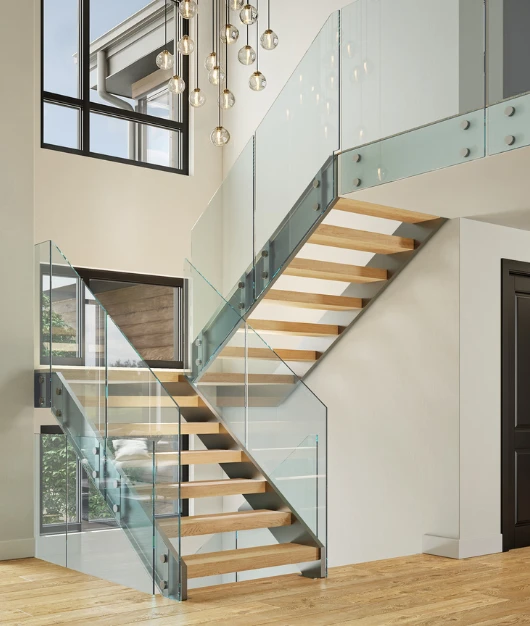
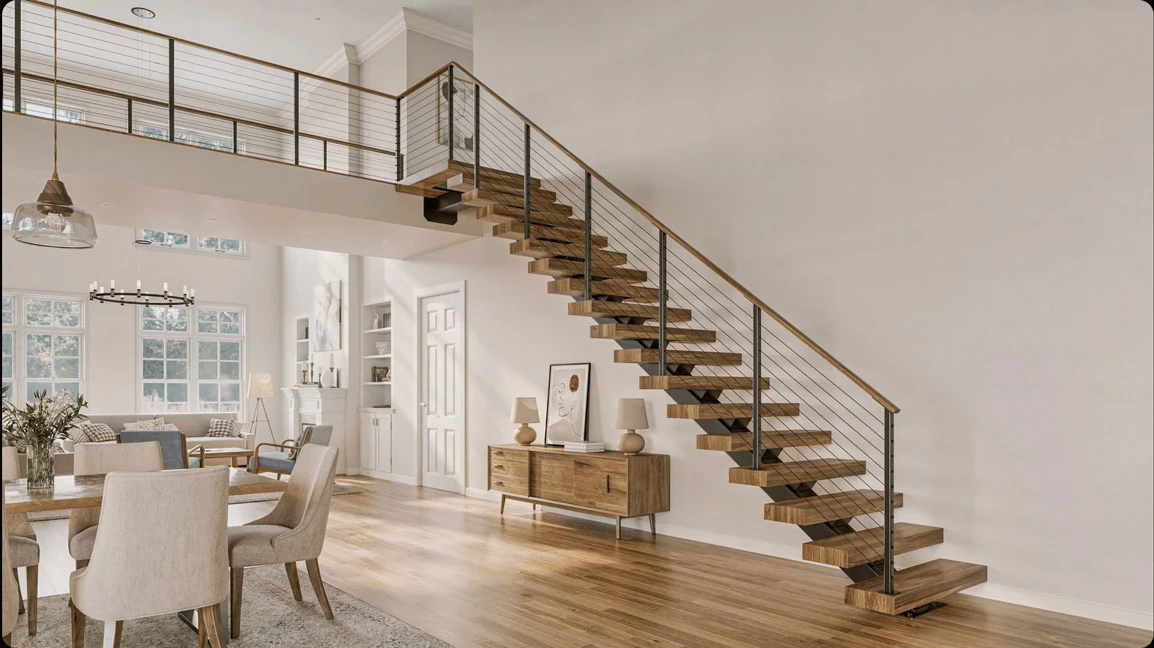
- Straight stair (9–10 ft floor-to-floor): 36″ width × ~11–12.5′ run + 3′ × 3′ bottom landing ≈ 41–47 sq ft (more with an upper landing or turns).
- L-shaped/U-shaped: add one or two 3′ × 3′ landings and a second run—commonly 50–65+ sq ft in tight homes.
- Spiral (by diameter):
- 42″ ≈ 13.4 sq ft
- 48″ ≈ 17.4 sq ft
- 54″ ≈ 21.7 sq ft
- 60″ ≈ 26.7 sq ft
- 66″ ≈ 32.1 sq ft
- 72″ ≈ 37.1 sq ft
(Smallest available diameter is 3’6″; 4’6″–5’0″ are frequent sweet spots.)
Note: We add about 2″ to each spiral’s diameter to account for handrail clearance and comfortable everyday use.
Quick math: Space savings vs. a ~45 sq ft straight stair (includes +2″ for handrail comfort):
- 50″ spiral (~17.9 sq ft) ≈ 60% smaller
- 62″ spiral (~21.0 sq ft) ≈ 53% smaller
- 68″ spiral (~25.3 sq ft) ≈ 44% smaller
Where a spiral unlocks the most usable space
- Lofts & mezzanines: Spirals tuck into corners, reclaiming 20–30 sq ft for seating, storage, or a workstation.
- Attic conversions: Spirals can meet IRC spiral stair provisions while threading through tight framing.
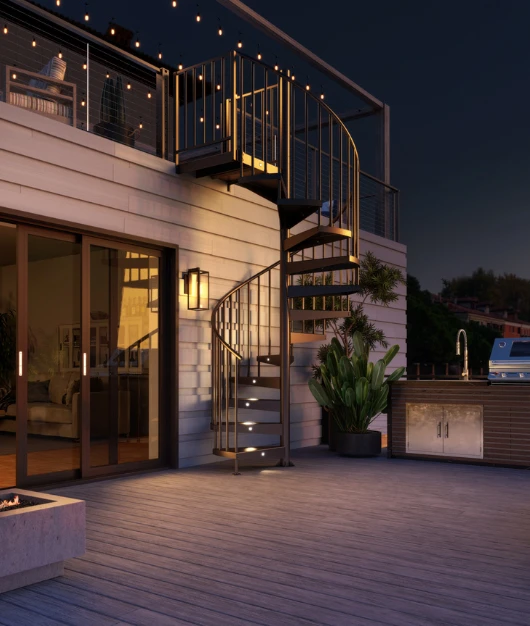
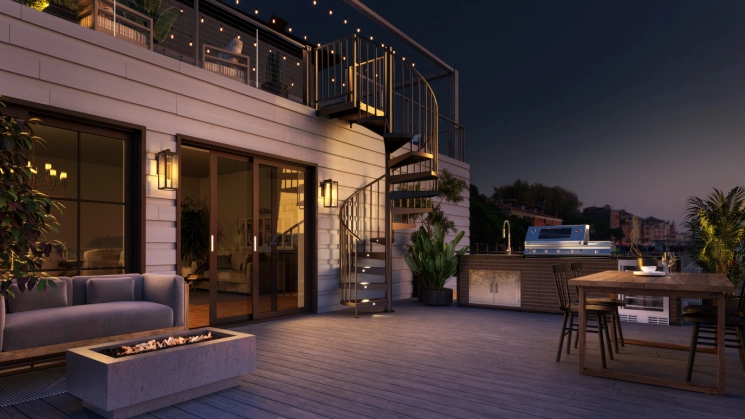
- Deck access: Outside, spirals avoid large switchbacks and extra landings. Choose weather-ready finishes like powder-coated aluminum or galvanized steel for durability.
- Small entries: A 4’–5′ diameter spiral can free the foyer for storage or better furniture flow.
Codes & comfort at a glance
- Straight stairs (IRC): min 36″ width, 10″ tread, ≤7¾” riser, 6’8″ headroom, 36″ landing minimum depth (The Spruce).
- Spiral stairs (IRC): min 26″ clear width, 7½” tread at 12″ from narrow edge, ≤9½” riser, 6’6″ headroom (ICC IRC R311.7.10.1).
Pro tip: Test your space before you order. Tape a square on the floor at 56″ and 62″ to see how much room each size needs.
Real-world comparison: 10′ floor-to-floor
Straight stair (36″ wide): ~12.5′ run + 3′ landing ≈ 46–50 sq ft.
Spiral 60″ diameter: ~26 sq ft.
Estimated reduction: ~50-55%. Plus, you can often stage usable storage or décor beneath and around the spiral.
Planning a loft or attic upgrade?
Grab the Safe & Stylish Loft Access Checklist to make sure your new stair meets both comfort and code.
Will a spiral help resale or perceived value?
While there isn’t a fixed percentage increase, real estate experts agree that buyers respond to usable square footage and visual impact. Spirals can make previously impractical square footage functional (like a finished loft or attic) and create a sculptural focal point that elevates photos and walkthroughs. According to The Spruce’s 2025 design forecast, “organic modern” design, mixing natural wood tones with clean architectural lines, is trending again, and a spiral with wood treads and a steel structure fits squarely within that aesthetic.
Choosing the right diameter
- Tightest spaces, maximum space savings: 42″–48″
- Daily use lofts, small families: 54″–60″
- Primary stair, frequent carries: 60″–72″+
Also consider handrail grip, tread surface (indoor wood vs. outdoor grip), and or additional center balusters. For material inspiration, browse indoor steel and wood spirals or outdoor aluminum designs.
Smart planning checklist
- Confirm floor-to-floor height and headroom.
- Pick a diameter for your space.
- Plan landing direction.
- Match materials and finishes to your space (indoor or outdoor, design style, etc).
Ready to see options for your space?
Use our interactive tool to configure size, materials, and finishes and talk to a designer in minutes.


